International freight transportation from Europe to Ukraine: export, broker services, customs clearance
If you need transportation of a commercial batch by a Euro truck, oversized cargo by special transport, express delivery by a van, transportation of bulk materials by dump trucks or delivery of products by a refrigerator — our company TobiPaczka is ready to offer a transparent service at every stage of the route, and our European brokers will quickly prepare export documents for you or for your counterparty.
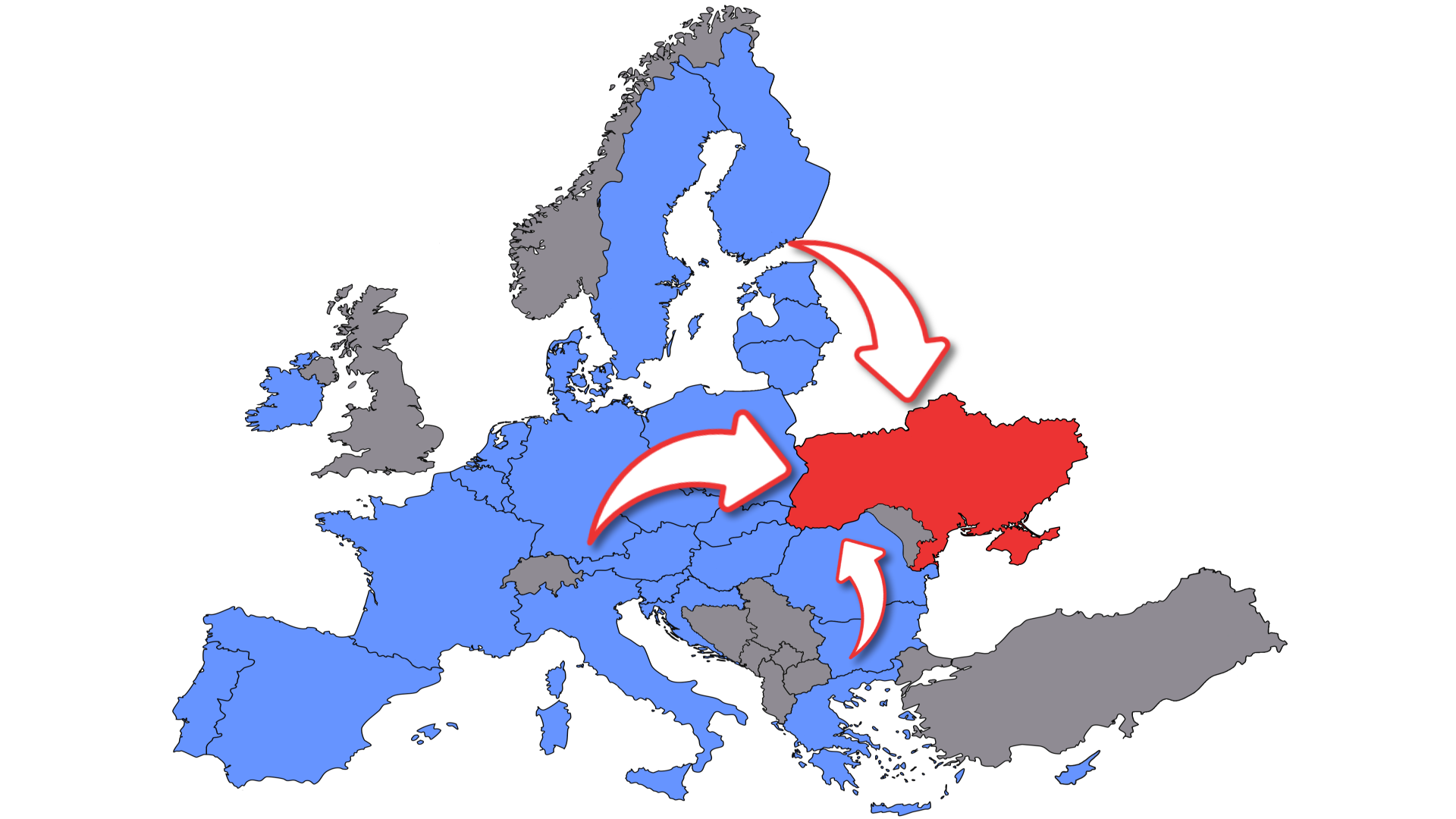
European countries from which you can order cargo delivery to Ukraine
We provide a wide range of logistics services, including freight transportation from the entire European Union. You can arrange freight from the following countries:
- Austria
- Belgium
- Bulgaria
- Hungary
- Germany
- Greece
- Denmark
- Ireland
- Spain
- Italy
- Cyprus
- Latvia
- Lithuania
- Luxembourg
- Malta
- Netherlands
- Poland
- Portugal
- Romania
- Slovakia
- Slovenia
- Finland
- France
- Croatia
- Czech Republic
- Sweden
- Estonia
Quick page navigation
Freight transport from Europe to Ukraine: our key services
International cargo delivery from Europe to Ukraine
We deliver cargo from Europe of any complexity — from a few pallets to large-scale consignments. Our fleet is equipped with transport for any task:
- curtain-sided trucks — for standard general and consolidated cargo;
- reefers — for products requiring a strict temperature regime;
- dump trucks and grain carriers — for bulk and agricultural cargo;
- lowboys — for oversized cargo;
- vans — for express delivery of small-sized shipments.
Customs support for export from Europe to Ukraine
We provide a full cycle of forwarding services for legal and fast export of goods from Europe to Ukraine. Our specialists will save you from customs routine:
- we help European suppliers correctly open the export declaration in the EU;
- we take over the organization of import and customs clearance in Ukraine;
- our own team of staff brokers guarantees border crossing without delays, overpayments and bureaucratic risks.
Trade representative in Europe
If you have found a European supplier but they do not work for export or refuse to prepare documents for shipment to Ukraine, we will take over this task:
- we help find the right wholesale suppliers and conclude contracts;
- if necessary, we purchase products from any sellers in the EU through our own European legal entity and resell the goods to your Ukrainian company;
- we prepare all export documents and arrange logistics to Ukraine.
Courier delivery of parcels and purchases from Europe to Ukraine for individuals
We care not only about large-scale freight transport for business, but also offer a convenient service for private customers. Fast, profitable and without overpayments or border delays:
- we promptly bring personal belongings, documents and parcels to Ukraine;
- we help pay for and deliver your online orders from any European online stores, auctions and outlets;
- we arrange tax refunds on purchases made in Europe, allowing additional savings.
Comprehensive logistics from Europe to Ukraine
We adapt logistics schemes to the specifics of each individual order, offering customers a wide range of specialized services:
- Transportation of standard cargo: prompt delivery of commercial batches of goods, palletized cargo, building materials and industrial raw materials by Euro trucks.
- Transportation of oversized and heavy cargo: professional transportation of large-sized machinery, agricultural machines, construction equipment and heavy industrial structures using specialized platforms and low-bed trailers.
- Delivery of bulk and agricultural cargo: transportation of grain crops, building materials and bulk cargo by modern dump trucks from EU countries.
- Consolidation and delivery as partial load: consolidation of small batches at our European warehouse and subsequent dispatch to Ukraine by a single vehicle.
Formats of international delivery from Europe to Ukraine
For commercial clients regularly engaged in foreign economic activity, we offer two key formats:
Full truck load
This format implies renting a separate truck or special transport for the needs of one customer. This is the most profitable and fastest option for transporting wholesale batches of goods and large cargo.
Express delivery by van
An ideal solution for urgent transportation of small commercial batches or pallets. Delivery is carried out by cargo vans, ensuring maximum speed of the route and customs checkpoints. The weight limit is up to 1200 kg.
Cost of freight transport from Europe to Ukraine
We adapt our pricing to fit your needs and budget.
Rates for commercial freight transport from the European Union to Ukraine
- trucks: from 800 €;
- vans: from 400 €.
The final cost directly depends on the total route length. The approximate rate is from 0.3 to 1.5 € per kilometer. In case of delays at customs checkpoints or downtime due to the cargo owner's fault, a charge of 50-100 € per each day of downtime is applied.
What affects the cost of cargo transportation from Europe to Ukraine
- Use of consolidated transport: the "partial load" format allows significant cost reduction, as you do not overpay for empty space in the truck.
- Category and specifics of cargo: transportation of dangerous (ADR), perishable or oversized goods costs more, as it requires special transport, special certificates or extended insurance.
- Package of accompanying documents: the need to prepare and verify international transport waybills, export documents, customs declarations, etc.
Transport for freight transport from Europe to Ukraine: available fleet
Trucks and heavy-duty semi-trailers
Classic road trains consisting of a tractor unit and semi-trailer, meeting strict EU environmental and technical standards. This is a basic tool for transporting large cargo and commercial batches.
Curtain-sided semi-trailers (curtain and board-curtain)
The most demanded body type, providing reliable protection of cargo from atmospheric precipitation and road dust with minimal dead weight of the semi-trailer.
- Curtain-sided semi-trailer: the design allows sliding the roof and side parts of the curtain independently of each other. This ensures maximum speed and convenience for top or side loading using forklifts and cranes.
- Board-curtain: the design combines strong folding boards in the lower part of the body and a sliding curtain on top, guaranteeing enhanced safety and reliable fixation of heavy items.
What they transport: any goods that do not require a strict temperature regime — electronics, household appliances, clothing, textiles, furniture, auto parts and long-life food products.
Flatbed semi-trailers and "shalanda"
Open cargo platforms with strong removable or folding sides, designed for goods insensitive to weather conditions.
- Clean flatbed: completely open flat platform for standard industrial cargo.
- "Shalanda": extended open platform for long-length structures.
- Flatbed with stakes: platform equipped with vertical steel racks (stakes) excluding displacement or rolling of cylindrical items.
What they transport: building bricks, concrete slabs, rolled metal, pipes, timber, industrial equipment and small-sized special machinery.
Specialized temperature-controlled transport
Isothermal semi-trailers
Sealed bodies made of modern sandwich panels with a thick layer of thermal insulation material (polyurethane foam). They work on the principle of a thermos — preserving the internal temperature of the cargo at the time of loading, preventing heat exchange with the environment. They do not have their own refrigeration unit, so they are effective on short and medium distances (up to 10–15 hours in transit). Rubber seals on the doors guarantee complete tightness, and galvanized internal surfaces are easy to sanitize.
What they transport: fresh vegetables, fruits, greens, dairy products, cheeses, confectionery, live plants, as well as beverages and cosmetics for which sharp temperature drops or winter freezing are critically dangerous.
Refrigerated trucks (reefers)
High-tech thermally insulated semi-trailers equipped with autonomous refrigeration and heating units (TRU). Unlike isotherms, the reefer actively generates and strictly maintains a set climate regime in the range from −20 °C to +12 °C (in some models up to +25 °C) on routes of any length. The vehicles are equipped with continuous monitoring sensors and temperature recorders, recording the temperature history for reporting to the customer.
According to ATP specification, reefers are divided into classes:
- Class A: from +12 °C to 0 °C (for cooling perishable products).
- Class B: from +12 °C to −10 °C.
- Class C: from +12 °C to −20 °C (for deep freezing).
Modifications:
- Multi-temperature: divided by internal insulating partitions into zones with autonomous temperature regimes.
- Double-deck: equipped with a beam system for double-deck pallet placement, doubling the capacity up to 66 pallets without the risk of crushing the lower rows.
- Carcass carriers: equipped with ceiling rails with hooks for transporting meat carcasses.
What they transport: frozen food products, deep freeze (meat, fish, semi-finished products), vaccines, medicines with strict "cold chain" requirements, chemical components and live flowers.
Special transport for oversized and heavy cargo
For transporting oversized and heavy cargo, lowboys are used — specialized heavy-haul semi-trailers. Their main feature is the absence of a body and the presence of a strong open platform. The number of axles is from 2 to 8 or more, which allows increasing the carrying capacity up to 120 tons.
Classification by loading height:
- High-bed (from 1000 mm and above): characterized by large ground clearance and large-diameter wheels. Used primarily in off-road conditions, on winter roads or construction sites with difficult terrain.
- Low-bed (600–900 mm): the gold standard for transporting special machinery. Allows safe transportation of most vehicles on public roads, ensuring a low center of gravity.
- With a lowered cargo platform / "trough" (300–500 mm): the platform has a broken frame (lowers between the tractor axles and the wheels of the trailer itself). Ideal for very high cargo (e.g. combine harvesters or tanks).
Classification by platform design:
- Straight platform: classic flat platform, convenient for cargo with even weight distribution (wheeled vehicles, containers, boxes).
- Trough-shaped platform (broken frame): has a recess in the center to reduce the loading height.
- Telescopic (extendable) lowboys: the frame can extend (single, double or triple), increasing the platform length from standard 9–13 meters to 20–40 meters. Indispensable for long-length cargo (pipes, bridge beams, blades).
What they transport: construction and quarry equipment, industrial machinery, long-length structures.
Dump trucks and grain carriers for bulk cargo
Cargo vehicles with an automatic hydraulic unloading mechanism, eliminating the need for manual labor or third-party loading machinery, which significantly reduces logistics operation time. For international routes, bodies are necessarily covered with dense protective tarpaulins (covers). The carrying capacity of European dump truck road trains is 25–30 tons.
Classification by unloading type:
- Rear: traditional and most reliable design for semi-trailers.
- Side: optimal for unloading on grain flows and inside warehouses with low ceilings.
- Three-way: universal vehicles with the ability to unload in any direction.
Classification by body material:
- Steel (Hardox): have increased wear resistance, used for heavy construction and industrial materials (ore, crushed stone).
- Aluminum: lightweight bodies of increased volume (from 50 to 90 cubic meters). Used in the agricultural sector, as the reduced dead weight of the trailer allows transporting more useful agricultural cargo without violating weight control on the roads.
What they transport: grain, rapeseed, soybeans, meal, compound feed, building crushed stone, sand, coal, as well as wood chips and pellets.
Algorithm of international cargo transportation from Europe to Ukraine: how delivery works
Organization of freight transport from European countries to Ukraine is a strictly verified action algorithm guaranteeing timely delivery:
- Receipt and processing of the request: analysis of cargo characteristics, selection of the optimal transport type and route approval.
- Conclusion of contract and insurance: official transportation contract and insurance policy for financial protection of the cargo.
- Provision of transport and loading: delivery of the vehicle to the sender's warehouse in the EU on a strictly agreed date.
- Customs clearance in Europe: processing of export declarations and the international waybill CMR.
- Transportation and border crossing: safe route passage and border control.
- Customs clearance and release of cargo: customs clearance of goods in Ukraine and final delivery to the recipient's warehouse.
Main documents and stages of international cargo delivery from Europe to Ukraine
International waybill CMR: filling rules
The CMR waybill is the main legal document regulating international transportation. Any mistake or absence of mandatory stamps in the CMR will definitely lead to border delays and fines from regulatory authorities.
- Field 16 (carrier): here the stamp and details of the transport company are mandatory.
- Field 22 (loading): place for the sender's (European factory or warehouse) signature and wet stamp. The absence of a stamp in this field means that the cargo was not legally accepted for transportation.
- Field 23 (confirmation of cargo receipt): driver's signature and stamp. By signing, the driver confirms the correctness of the cargo count and the integrity of the external packaging. If the driver was not allowed to supervise the loading or packaging defects are found, notes are entered in field 18 ("Carrier's reservations"): "Loading carried out by the sender, counting of packages is impossible" or "Packaging damage found on 2 pallets."
- Field 13 (customs): the exact address and code of the internal customs terminal in Ukraine to which the vehicle must arrive for customs clearance. Changing the address en route without customs approval is a gross violation.
Critical steps of cargo transportation to Ukraine
Step 1: Loading in the EU → Step 2: EU Border → Step 3: Ukraine Border → Step 4: Customs and Unloading
Step 1. Loading in Europe
The driver accepts the invoice, packing list and export declaration, on which the barcode and the international registration number MRN (e.g. 26PL321000…) must be printed. At this stage it is critically important to verify that the net/gross weight and the number of packages in all three documents (invoice, declaration and CMR) match to the kilogram and to the unit. Any discrepancy is a reason for customs to stop the vehicle.
Step 2. Control at the EU border (Poland, Romania, Slovakia, Hungary)
At the EU customs post, the CMR and the declaration (with MRN number) are presented to the inspector. The most important thing: to make sure that the customs officer scanned the barcode of the document and officially "closed" the export in the electronic system. Without this, the European supplier will not receive confirmation of the goods' export, will not be able to claim VAT refund or zero-rating and will file a claim against the importer. On the CMR copy, the European inspector stamps the border crossing.
Step 3. Entry through the Ukrainian border
Before passing the Ukrainian checkpoint, the driver declares the number of the preliminary declaration (PN/PD). Without a valid electronic PN/PD number, the vehicle will not be allowed onto the territory of Ukraine. After checking the documents, Ukrainian customs officers attach a special customs seal to the locking mechanisms of the trailer and put a mark in the CMR.
From this moment until arrival at the domestic customs, it is strictly forbidden to tear off or damage the seal. Unauthorized removal of the seal entails confiscation of the cargo and huge fines.
Step 4. Clearance at the domestic customs in Ukraine
After the truck enters the domestic customs terminal, all original documents are transferred to the Ukrainian broker. Upon completion of customs clearance, the inspector removes the seal and puts the final stamp in the CMR waybill ("Cargo cleared" / "Release allowed"). Only after this is the vehicle entitled to leave the terminal for the unloading warehouse. When handing over the goods, the recipient signs and stamps the CMR ("Cargo received"), confirming the successful completion of the logistics operation.
How to arrange delivery from Europe without errors and cargo delays
To make international delivery as smooth as possible, we recommend paying attention to the following practical aspects:
- Preliminary document audit: send scans of invoices and packing lists to our specialists or your broker before the actual loading of the vehicle. This will allow correcting typos in names, weights and HS/CN codes calmly.
- Weight control: European regulatory authorities strictly monitor compliance with weight parameters and axle loads. Overloading the vehicle or incorrect distribution of heavy cargo inside the trailer will lead to large fines.
- Pallet parameters: make sure the goods do not protrude beyond the edges of the Euro pallet (1200×800 mm), and the wooden packaging itself has the phytosanitary treatment stamp (ISPM 15). The absence of the stamp may be a reason for the return of the entire cargo by the border veterinary and phytosanitary service.
Calculate the cost of cargo transportation from Europe to Ukraine
In order for us to quickly calculate the exact cost of cargo transportation from Europe and check the availability of free transport for your dates, please send a Request to a manager with the following information:
- required vehicle: curtain-sided, lowboy, reefer, dump truck, light-duty van;
- Cargo parameters: name, actual weight, dimensions (L × W × H), estimated value;
- Route: cargo pickup address in Europe, planned customs clearance location and final unloading point in Ukraine;
- Delivery terms: according to international Incoterms rules (e.g. FCA, EXW, DAP);
- Time window: desired date range for loading organization;
- Payment form and budget: cashless or cash, payment terms (prepayment or strictly payment upon unloading), and optionally your target budget proposal.
Arrange international cargo delivery from Europe to Ukraine
Leave a request in a messenger convenient for you or call us at the indicated number. We will select the optimal solution for your request, provide a free consultation and help calculate the cost of cargo delivery or turnkey export services from Europe to Ukraine.
📞 Phone: +380‑68‑67‑32‑368
📧 Email: info@tobipaczka.com
Export from Europe to Ukraine: delivery terms and documents
Incoterms: international delivery terms for goods
Incoterms are international rules that unify the conditions of goods transportation. The correct choice of Incoterms basis allows clearly delineating financial costs, risks and obligations between the seller, buyer and logistics operator.
We offer three main options for delivery of goods from Europe to Ukraine:
EXW (Ex Works)
EXW — the option with maximum buyer responsibility. The seller only provides the goods at their warehouse in Europe, and the buyer independently arranges cargo pickup and is responsible for export and import clearance.
FCA (Free Carrier)
FCA — the seller delivers the goods to the specified place in Europe and hands them over to the carrier, processes export documents and transfers further responsibility to the buyer.
If your Ukrainian company purchases goods in the European Union on EXW (pickup from the manufacturer's warehouse) or FCA (handing over the goods to the designated carrier at the agreed place) terms, we take over the complete turnkey organization of transportation.
- Local pickup: collection of full cargo by our transport from factories and plants across Europe, or collection of individual batches at our central transit warehouse.
- Warehouse services: processing of consolidated cargo at our consolidation warehouse in Poland, including weighing, labeling, palletizing, repacking and storage.
- Customs brokerage services in the EU: opening of the export declaration.
- Freight: main international cargo transportation along the optimal route.
- Brokerage services in Ukraine: preparation and submission of declarations (PN/PD) for border control and organization of final customs clearance at the domestic terminal.
DAP (Delivered at Place)
DAP — the seller delivers the goods to the agreed destination, but does not handle unloading. All customs procedures and payment of import duties remain with the buyer. In this case, the seller of the goods can directly act as the customer of our transport services. We offer European exporters reliable solutions:
- Direct delivery to Ukraine without reloading: our transport has all necessary insurance policies and permits for operation in the Ukrainian region.
- Economical scheme with cross-docking: the European carrier delivers the goods to our border warehouse in Poland (Chelm). We quickly reload the products into our vehicles and carry out subsequent delivery across Ukraine. This reduces the rate and removes risks from European partners.
What documents are needed for export from Europe
What our company (carrier) is responsible for
- CMR (international waybill): we issue 3–4 original copies.
- Permit / ECMT: provision of permits for international road transport.
- Export declaration (EX-1 / EX-A): document to confirm export from the EU. Processed by our European broker if we open the export, or directly by the European seller (exporter).
- PN or PD (preliminary declaration / notification): without a registered number, entry of the cargo vehicle into Ukraine is legally prohibited. Processed by our Ukrainian broker or the Ukrainian buyer (importer).
What the client (Ukrainian importer / European exporter) is responsible for
- Commercial Invoice: official invoice from the European seller indicating the value, exact details of the parties and delivery terms.
- Packing List: document with a detailed description of packages, packaging dimensions, net and gross weight.
- Customs power of attorney: needed by our broker in the European Union to declare export on behalf of the seller.
- Certificate of origin EUR.1: based on the Association Agreement between Ukraine and the EU, in order for the Ukrainian importer to import goods from Europe at a reduced or zero duty rate, it is necessary to confirm the preferential European origin of the cargo (if needed, we can help process it).
In order for our European broker to represent the interests of the seller (exporter) at customs and submit the declaration on their behalf, the seller is obliged to sign a customs power of attorney (in Poland it is called Upoważnienie, in other EU countries — Customs Authorization or Power of Attorney). We will provide such a document: the seller must sign it and send a scan to our email, and send the original by registered mail to the address of our customs agency in the EU. If the seller refuses to issue a power of attorney and does not want to deal with export issues, our company can purchase their goods in the EU territory and independently carry out the turnkey export to Ukraine.
How to open export in Europe
According to the strict Incoterms rules, for example under DAP terms, the seller (exporter) is obliged to export clearance themselves. This is their legal area of responsibility. However, in practice there are two main options for processing export documentation:
The export is opened by the European seller (exporter)
This is the ideal option. The European seller has their own team of brokers. They themselves prepare the invoice, packing list and issue the export declaration with its barcode. When the vehicle is provided, the driver is simply handed a ready printed sheet with the MRN number.
The export is opened by our broker
Very often European sellers (especially small, medium ones or those who rarely trade with non-EU countries) tell the Ukrainian buyer: "We are ready to sell you the goods on DAP terms and even pay the freight to Ukraine. But we do not know how and do not want to deal with European customs for arranging export to Ukraine. We do not have our own broker." In this case, the contract terms remain DAP, but export opening procedure is delegated to us (the carrier).
How it is done technically:
- the European seller provides us with a standard invoice and packing list;
- the seller is obliged to sign a contract with our broker, according to which it will be possible to process all necessary customs documents for export;
- our staff European broker (e.g. at our consolidation warehouse in Poland or at a border terminal) on the basis of these documents themselves opens the export.
In the declaration in the "Exporter/Sender" field, our broker still indicates the European seller (their details and EORI). Our broker acts only as a technical declarant (representative). The vehicle goes to the border, the export is closed, and the European seller receives their confirmation of cargo exit and calmly reclaims their VAT.
How the export of goods from Europe takes place
What our company (carrier) does
- Order acceptance: receiving from the client the contacts of the sending factory, invoice and packing list, agreeing on the date of cargo readiness.
- Vehicle provision: timely provision of the vehicle for loading at the European supplier's warehouse.
- Loading control: the driver checks the visual integrity of the packaging, counts the number of packages and fills in the CMR waybill.
- Customs in the EU: if the export is opened by the seller of the goods, the transport proceeds to the customs terminal specified by the sender, where export is opened (sometimes the seller hands over the cargo already with ready export documents). If the export is opened by our broker — the transport proceeds to our European broker, who will himself process the export declaration.
- Crossing the EU border (entry into UA): the vehicle arrives at the border checkpoint. European customs closes the declaration, which is the official confirmation of export for the European seller (basis for VAT refund). Before entering the Ukrainian control zone, the driver enters into the electronic system the PN/PD number provided by the client or our broker.
- Customs clearance in Ukraine: the transport arrives at the domestic customs terminal of destination and awaits completion of customs clearance by the client's broker (or by our company's broker).
- Unloading: delivery of the cleared goods to the client's warehouse and handover of the original CMR with marks of receipt.
What the client (Ukrainian importer) is obliged to do
- Preparation of documents: pay for the goods to the European supplier, obtain the commercial invoice and packing list.
- Arranging delivery: provide the sender's contacts and conclude a transportation contract with us.
- Customs in Ukraine: send the package of documents to their Ukrainian customs broker or to our company's broker.
- Customs payments: timely pay customs duties and import VAT to the state account.
- Unloading: accept the customs-cleared cargo at their Ukrainian warehouse, signing the CMR.
Ensure processing of PN/PD by the broker at Ukrainian customs and transfer its number to our driver before the vehicle approaches the Ukrainian border.
Support for cargo export from Europe to Ukraine by a customs broker
In addition to transportation, we offer full export support — a set of services in which all stages of goods delivery from the EU supplier to your warehouse in Ukraine are handled by our company.
Popular export support formats
- Broker assistance in Europe — a European broker helps correctly purchase goods and process export documents.
- Broker assistance in Ukraine — Ukrainian specialists prepare the documents necessary for import and accompany the customs clearance of the cargo.
- "Turnkey export" service — you receive already processed and cleared European goods at your warehouse in Ukraine without the need to delve into customs nuances.
What is included in turnkey export support
- Analysis and preparation of the transaction: verification of the foreign manufacturer, agreement on delivery terms, selection of Incoterms and execution of a foreign trade contract.
- Logistics: selection of the optimal route, arrangement of transport, cargo movement monitoring and insurance.
- Customs clearance: work of a customs broker, selection of HS/CN codes, calculation of Ukrainian duties and taxes, submission of customs declaration.
- Certification and permits: processing of documents necessary for legal import and sale of goods in Ukraine, as well as assistance in passing phytosanitary and veterinary control.
How to order export support services
To calculate the cost of export support from Europe to Ukraine, Send the data to a manager:
- commercial invoice and packing list;
- mass and dimensional characteristics of the goods;
- address and contacts of the cargo pickup location;
- Incoterms delivery terms.
Also indicate the required work format: assistance with purchase of European goods; export preparation from the EU; only transportation across the border; customs clearance in Ukraine; or full "all inclusive" export support.
Trade representative in Europe: support of commercial transactions
Developing international trade? We will help establish uninterrupted product supplies, optimize costs and minimize risks. Our team provides trade representative services in the EU and is ready to take on the role of your reliable representative in the European market.
- Search for partners: we will find verified European suppliers and manufacturers, agreeing on the most favorable wholesale net prices for you.
- Purchase to a European company: if necessary, we can purchase various goods to our own company in the EU, consolidate the cargo and prepare it for dispatch with unified export documents.
The purchase service is especially relevant in cases where the European seller does not engage in export to Ukraine. Then our company in the EU buys out their products, takes them onto its balance, then processes the export and resells these goods to you. The purchase commission is 5%.
- Legal support: we will accompany the process of concluding foreign trade contracts within the framework of international law.
- Logistics: we arrange cargo transportation both within Europe itself and export delivery to Ukraine of any volume of goods.
- Customs clearance: we will take care of customs brokerage formalities, prepare the necessary documents and carry out customs clearance in Ukraine.
Frequently asked questions about international freight transport Europe → Ukraine
How long does it take to transport cargo from Europe to Ukraine?
On average, transportation takes from 3 to 7 days. Exact times depend on the distance of the country of departure (e.g. transportation from Poland is faster than from Spain or Italy), the selected format (FTL or LTL), as well as the current workload and queues at road border crossing points.
What is an export declaration EX-1 and why is it needed?
The export declaration EX-1 is an official customs document that is issued for goods produced in EU countries and exported outside their borders. It confirms the fact of product export and is the main basis for the European supplier to legally sell the goods without domestic VAT or to reclaim it later.
Can I track the movement of my cargo during transportation?
Yes. All vehicles in our fleet are equipped with GPS monitoring systems. You can at any time get up-to-date information about the vehicle's location by contacting your personal logistician.
What is the fundamental difference for a Ukrainian buyer between EXW and FCA terms?
The main difference lies in the point of transfer of risks and responsibility for customs clearance in the EU:
- Under EXW (Ex Works): the seller only hands over the goods at their warehouse. You, as the buyer, are obliged at your own expense to pay for loading into the vehicle and independently open the export declaration at European customs.
- Under FCA (Free Carrier): the European seller is obliged to independently load the goods into our vehicle and at their own expense process the export declaration.
Our recommendation: for business, FCA terms are safer and more convenient. However, if the factory insists on EXW, we completely take over local pickup, loading and processing of export documents through our brokers. For more details on the pros and cons of each delivery option, read our article: Incoterms conditions for import and export.
What happens if at the EU border customs does not close the export declaration?
If the inspector at the border does not scan the barcode of the declaration (MRN number), the goods in the EU customs authorities' system will be listed as not exported. In this case, the European supplier will not be able to confirm the 0% VAT rate to their tax office and will be forced to pay the internal tax of their country. After that, the supplier will charge this amount as a claim to the Ukrainian buyer or carrier.
Sometimes the cause is an inspector's error. In this case, it is necessary to contact the customs or tax authorities of the relevant country, provide a set of documents and, crucially, confirmation from Ukrainian customs that the goods were indeed imported from the EU. This proves the fact of export, allowing the supplier to reclaim European VAT.
What is the difference between a preliminary declaration (PD) and a preliminary notification (PN), and what is needed for our cargo?
Both documents are processed by a broker in Ukraine before the vehicle approaches the Ukrainian border, but they are used for different categories of cargo:
- PD (preliminary declaration): issued for goods subject to mandatory taxation (duty, excise, import VAT). The PD number confirms that the importer has already deposited the necessary funds into the customs settlement account as a guarantee.
- PN (preliminary notification): used for goods exempted from duties (e.g. humanitarian aid, certain types of raw materials or equipment) or going in transit mode.
Without a valid PD or PN number in the electronic system, Ukrainian customs will not let the cargo vehicle through to the territory of Ukraine. More detailed information is given in the article: PN, PD and ENS: what are they and when are they needed?
The European supplier sells goods on DAP terms but categorically refuses to deliver them to Ukraine. What to do?
This is a standard problem, as European insurance companies often cancel comprehensive and liability insurance policies when crossing the Ukrainian border. We solve this problem in two ways:
- Direct delivery by our transport: our company has all necessary international licenses, Ukrainian registration and specialized insurance valid under martial law. The European supplier hires us, entrusts the cargo, and we deliver it directly without reloading.
- Cross-docking via a warehouse in Poland: the European carrier brings the cargo to our transit warehouse in the border zone. There we reload the goods "from vehicle to vehicle" and deliver them to Ukraine by our own transport.
What to do if during loading at the factory in Europe the actual weight of the cargo diverges from the invoice?
If the driver during loading or weighing at an intermediate warehouse discovers a weight discrepancy (even by a few tens of kilograms), the vehicle cannot be sent to the border. A discrepancy between commercial documents (Invoice, Packing List) and the export declaration at Ukrainian customs will be interpreted as a violation of customs rules or smuggling, leading to the vehicle's arrest and large fines. In such a situation, loading is suspended, and the supplier must quickly reissue the invoice or adjust declaration to the actual data.
Who should fill in the international waybill CMR — the sender or the carrier's driver?
According to the international CMR convention, the obligation to fill in the waybill lies with the sender of the cargo. However, in practice, most fields (data on the vehicle, permits, route) are filled in by our company's driver or a broker at the consolidation stage. At the same time, the sender is obliged to personally fill in the fields relating to the goods description, weight and special instructions, and also to put their original stamp and signature in field 22. Without the sender's stamp, the CMR waybill is considered invalid. The process is described in more detail in the section: Key stages and documents for export.
What is TIR Carnet and is it needed for cargo delivery from the EU to Ukraine?
TIR stands for Transports Internationaux Routiers (international road transport). Carnet TIR (TIR carnet) is a customs cargo accompanying document that grants the right to transport goods across state borders in sealed vehicle cargo compartments or containers using simplified customs procedures. At each border, the next part of the Carnet TIR is detached by local authorities with passage registration. In the destination country, final clearance and surrender of the remaining detachable sheets take place. Financial guarantees are the most important component of the system: the guaranteeing association in each country undertakes to cover possible state losses if the cargo does not arrive at the final destination.
Is TIR needed for delivery from the EU to Ukraine? No, TIR Carnet is not mandatory for direct delivery from the EU to Ukraine. There are no transit countries — the cargo goes directly from the EU to Ukraine, so the main advantage of TIR (simplified transit through several borders) is irrelevant.
When can TIR still be applied? TIR is useful if the cargo goes in transit through several countries (e.g. through a third country), and the carrier wants to avoid separate clearance at each border.
What is the T1 / T2 declaration (NCTS system) and is it needed for freight transport from the EU to Ukraine?
NCTS (New Computerised Transit System) is an electronic customs transit management system used within the framework of the Convention on a Common Transit Procedure. One declaration in NCTS covers transit through the EU, Great Britain, EFTA countries, Turkey, Ukraine, Georgia and other Convention participants. All documents are submitted and tracked electronically — no manual work at each border. Since October 1, 2022, in connection with Ukraine's accession to the Convention on a Common Transit Procedure, uniform rules for regulating transit operations have been established, and on April 22, 2024, Ukraine transitioned to NCTS Phase 5, fulfilling its obligation to its European partners.
- Goods produced outside the EU → T1 is needed: T1 is a transit customs declaration that allows moving goods not in free circulation in the EU through the territory of European Union member countries without paying customs duties in the transit country. In fact, it is a guarantee document: the goods travel through the EU "under control", and the customs of the departure and destination countries record the opening and closing of the procedure. Typical example: Chinese goods are transported in transit through the EU.
- Goods produced in the EU → T1 is not needed: if the goods are of European origin (e.g. a Polish manufacturer ships its products to Ukraine), it is not foreign cargo on the EU territory. Standard documents are sufficient: CMR + invoice + packing list + declaration EX-1.
- T2 is needed: goods with EU status under a T2 declaration can move through common transit countries outside the European Union. Example: goods go from Poland to Romania, but the route passes through Ukraine (which is geographically possible). The cargo has EU status, and so that it does not lose this status while traveling through Ukrainian territory, T2 is issued.
- T2 is not needed: example: direct delivery from EU → Ukraine (final destination). The goods are simply exported.
Is a customs stamp needed on export forms?
The electronic export declaration is closed by customs automatically through the Export Control System (ECS) — as soon as the actual export of goods outside the EU is confirmed. As of 2026, paper stamps on the declaration are not used. The customs of Ukraine (or any other country outside the EU) also does not put stamps on this declaration. In order for the goods supplier to officially confirm the fact of export, the following steps must be taken:
- MRN check at the border: make sure that when crossing the EU border, the customs officer scanned the unique declaration number — Movement Reference Number. It is this that records the export of goods in the system.
- Obtaining electronic confirmation: the carrier or customs broker must download from the customs database an electronic confirmation of the declaration closure — the so-called Exit Note. This document is the official confirmation of export.
- Submission to the tax office: the obtained electronic document (or a printout with the MRN number) must be provided to the tax inspection to justify the zero VAT rate.
What is MRN and what is it for?
The abbreviation MRN stands for Movement Reference Number (in some systems the term Master Reference Number is also used) — this is a unique registration number of the customs declaration in the electronic export and transit control systems of the European Union countries, as well as the states participating in the Convention on a Common Transit Procedure. The MRN number is generated automatically by the customs system at the moment of electronic submission and registration of the declaration by the broker. By the time the cargo reaches the EU border, the MRN already exists: it is printed on the accompanying document (SAD) in the form of a barcode and handed over to the driver in advance.
Code structure: 18 alphanumeric characters. The first two — the year of registration (e.g. 26), the next two — the code of the country of departure (e.g. DE — Germany, PL — Poland), the remaining 14 characters — a unique identifier automatically generated by the customs system. Example: 26PL44000012345678.
What it is used for: it allows tracking the movement of cargo in real time, checking the customs clearance status (declaration opened, closed or overdue), and officially confirming the fact of crossing the EU border — including for VAT refund.
Notification / communicat IE599 / CC599C — what is it?
IE599 (export notification, also called communicat) is an official electronic document of the European Union customs authorities, confirming the actual export of goods outside the EU. CC599C — is a new, EU-wide designation of the same message. It is generated in the ECS (Export Control System) after the cargo crosses the customs border. Key features of the document:
- Confirmation of export: it is legal proof for tax authorities.
- Application of zero VAT rate: it allows the seller in the EU to process the transaction with 0% VAT or reclaim the previously paid tax.
Who needs it: primarily companies and entrepreneurs engaged in foreign economic activity and dealing with export/import of goods.